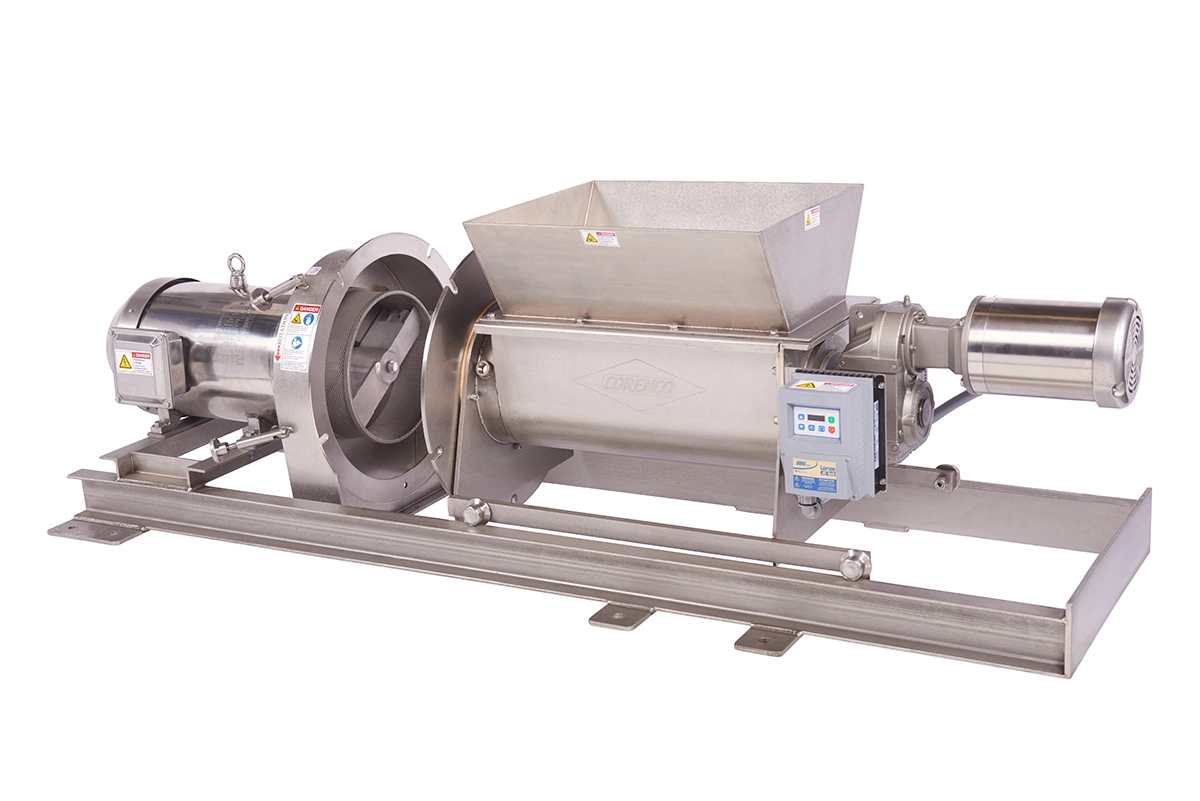
 In today’s food processing sector, increasing yield isn’t just a production metric—it’s a profit driver. One often‐overlooked step that has a huge impact on both yield and profitability is size reduction — i.e., properly grinding or disintegrating raw inputs so that downstream extraction, blending, pureeing or finishing steps perform optimally. In this post we’ll show how industrial food grinders help maximize yield, why that matters to your bottom line, then look at case‐studies (like legumes → hummus and nuts → butter), and finally share some practical tips on selecting screens and accessories.
The core idea: Industrial grinders create finer, uniform particles, you can extract more of what you want (juice, oil, soluble material, finished product) with less waste—and with less cost. As Corenco states: “Reduction of fibrous roots, soft vegetables, fruits … the primary purpose of food size reduction equipment is to increase the yield of the material. And increased yield increases profitability.”
Here’s how that plays out in practice:
Smaller particles = more surface area for extraction (for juice, oil, soluble solids)
More uniform size means more consistent downstream process (less under‐processed chunks, less over‐milled waste)
Less retention time, less waste, better capacity utilisation. As Corenco mentions: “Optimal size reduction is the key to … minimizing cost, retention time (and by implication, capacity), waste, and for maximizing yield.”
By improving yield you reduce your per‐unit cost (the raw material cost is better leveraged) which raises margin.
In a competitive market, the business that produces the highest yield and maintains highest quality “wins.”
Example for illustration:
If you process apples for juice, and by using a better grinder you extract, say, 5 % more juice per ton of apples, you get more finished product for the same input. That incremental volume can either reduce cost per pound or allow you to sell more, or both—hence boosting profitability.
Let’s talk numbers in simple terms:
Raw material cost is typically one of the largest components of your cost‐of‐goods‐sold (COGS).
If you can extract 2% more usable product (juice, puree, butter, etc.) from the same input, that’s effectively reducing COGS by 2% (assuming the rest of the process cost stays constant).
That 2% improvement in yield flows straight to margin or allows for more competitive pricing (or to invest in marketing, packaging, etc.).
On high‐volume lines, small yield improvements amplify: e.g., if you process 1,000 tons/month of a raw material, and each ton gives you 100 kg of finished product. A 2% yield gain is 2 kg more finished product per ton → 2,000 kg extra per month. Multiply by your margin and you can see real dollars.
Also, better yield often reflects better process efficiency (less waste, fewer rejects, less downtime) which improves throughput and capacity utilization.
In short, yield optimization via proper size-reduction equipment is not just an “engineering/operations” topic—it is core to business performance and marketing story.
Here are two strong use‐cases where industrial grinders drive yield and value.
1. Chickpeas → Hummus (Legumes to Finished Dip)
Legumes (e.g., chickpeas) are a popular input for dips like hummus, spreads and protein‐rich toppings. The process: cooked chickpeas → grinder/puree → blending with other ingredients → final product.
By using an efficient industrial grinder/disintegrator that ensures uniform size, minimal lumps, optimal particle size for blending, you get:
Better texture (a smoother finished dip, which customers prefer)
Less waste (less over‐grinding, fewer rejects)
Higher throughput (faster grinding → more batches)
Corenco mentions beans/legumes (hummus) as an explicit application of their size-reduction equipment.
2. Nuts → Nut Butter or Nut Milk
Nuts (almonds, peanuts, cashews, etc) processed into nut butters or nut milks require very consistent particle size reduction. If you under‐grind, you get a coarse product, separation issues, inconsistent mouth-feel. If you over‐grind you risk heat build-up, nutrient damage, flavor degradation. Using the right industrial grinder:
Enables optimal final particle size for smooth butter or milk
Enhances extraction of oil/fats (hence increasing yield)
Minimizes rejects, separation and waste.
Screen (or mesh) size matters
Smaller aperture screens produce finer particles, but that’s not always better. In many cases an overly fine grind costs more energy, may damage product, may reduce throughput, or generate unwanted heat or aeration. Corenco: “While many people imagine that the smallest possible screen size will help them create a more premium product, this is yet another place where talking to a manufacturer is critical.”
Bigger screens (coarser grind) may be fine for downstream processes that require larger particles (e.g., soups, chunky sauces) but will under‐extract if you’re aiming for high yield (juice, oil, fine puree).
Optimal screen size depends on: the product’s physical characteristics (wet vs dry, fibrous vs soft), downstream process (extraction vs puree vs finishing), final product specs (texture, mouth-feel). Use trials or send samples for vendor testing—Corenco offers free product testing.
Rotor and internal accessories
Rotor style (chopping rotor, butterfly rotor, paddle‐style) influences how the material is sheared/impacted inside the machine.
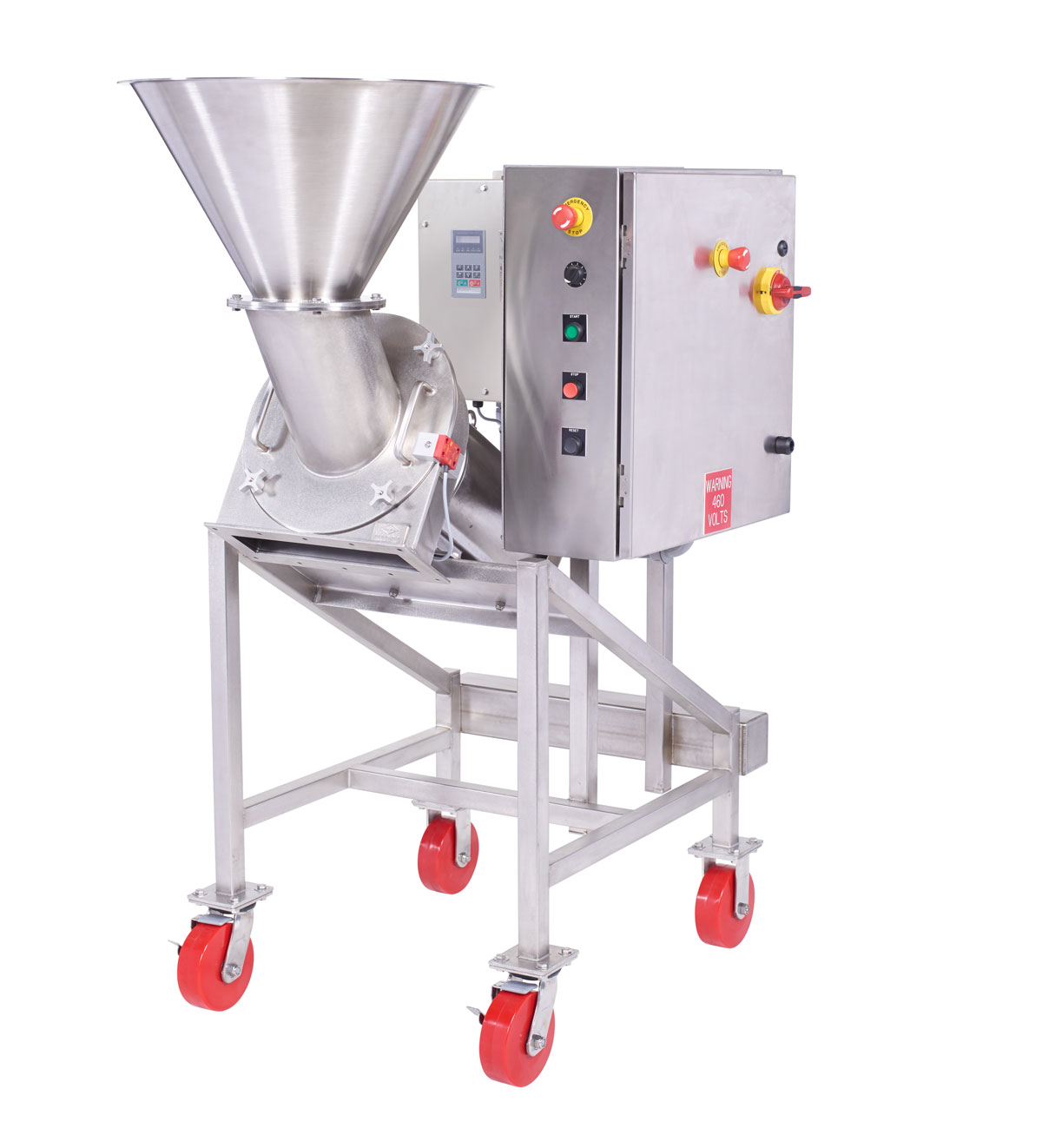
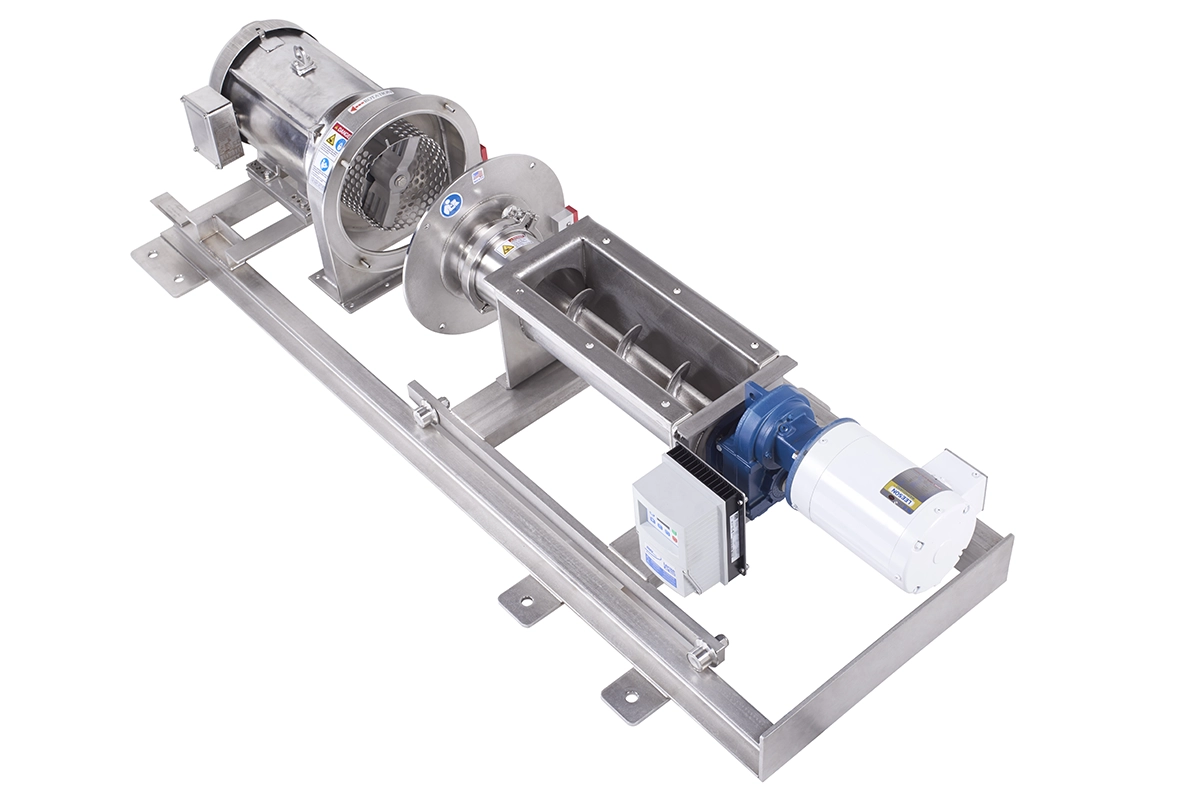
Accessories like feeders (screw‐fed vs gravity‐fed vs pump‐fed) matter depending on how sticky or wet the raw material is. For example, leafy greens or wet materials may need a screw‐fed disintegrator rather than gravity‐fed.
Make sure the machine is sanitary and easy to clean if you’re processing food (batch changes, allergens, etc.).
Maintenance & change‐out considerations
Screens wear: Corenco notes that screen lifespan is about 400 working hours (on average) for their machines.
Rotors last longer (e.g., ~2,000 hours) but should be monitored.
Choose equipment where screen swap‐out is quick and tool‐less if possible – fewer downtime losses.
Fit the machine to process volume and feed characteristics
Never assume one size fits all: if your volume doubles you may exceed machine capacity, reducing yield or increasing rejects. Corenco: “The application determines the model … the type of machine you want to invest in will depend largely on what you intend to use it for.”
Consider footprint, power, feed method, and integration into your line (pre‐crusher, disintegrator, finishing).
Work with vendor for trial/testing
Corenco offers testing: send your material, target size and they’ll trial different screens/rotors to optimize before purchase.
Use data from testing to quantify yield improvement, energy usage, throughput – these become marketing‐capable metrics.
For food processing operations aiming to maximize yield and profitability, size reduction should be treated as a strategic lever — not just a “grind it and forget it” step. By investing in the right industrial grinder, optimizing screen/rotor configuration, and aligning it with your product and downstream process, you can:
Improve yields (more juice/puree/butter from the same input).
Reduce waste and lower per-unit costs.
Improve product consistency and texture (a marketing advantage).
Increase throughput and capacity utilization (a business advantage).
Easily build marketing narratives around efficiency, sustainability and premium quality.
Product-Specific testing is the only way to know with certainty how equipment will perform with your product is to test your actual product under controlled conditions that mirror your operational requirements.
This isn’t about general capability testing or laboratory approximations. It’s about taking your specific raw materials, processing them through the exact equipment configuration you’re considering, and measuring the results against your precise quality and throughput requirements.

What Comprehensive Testing Should Include:
1. Your Actual Product
2. Realistic Processing Conditions
3. Comprehensive Analysis
4. Documentation
Why We Offer Free Product Testing
At Corenco, we’ve seen too many companies make expensive equipment mistakes because they didn’t have access to proper testing. That’s why we provide one hour of comprehensive product testing at no cost – no purchase commitment required.
Here’s our philosophy: if we can’t prove our equipment works with your specific product, you shouldn’t buy it. And if we can prove it works, you’ll have the confidence and data needed to make a smart investment decision.
Our Testing Process:
The testing gives you exactly what you need to answer that critical question: “Will this equipment actually work with our specific product?”
Making Data-Driven Equipment Decisions
With proper testing data, your equipment selection process transforms from educated guessing to data-driven decision making. You can walk into that management meeting with confidence, armed with:
Questions to Ask Any Equipment Vendor
Before making your next equipment purchase, ask potential vendors:
If a vendor can’t or won’t provide comprehensive product testing, consider that a red flag. Equipment performance with your specific product should never be a mystery.
Your Next Step
Don’t let your next equipment purchase become another expensive gamble. Whether you’re considering Corenco equipment or evaluating other vendors, insist on comprehensive product testing before making any commitment.
For Corenco testing: Simply contact us with your product requirements, and we’ll coordinate sample shipping and testing logistics. No cost, no commitment – just the answers you need to make confident equipment decisions.
For other vendors: Use the testing criteria outlined above to evaluate their capabilities and willingness to prove performance with your specific products.
Remember: the question isn’t whether the equipment works. The question is whether it works with your product, in your environment, to meet your specific requirements. Testing is the only way to know for certain.
Ready to get definitive answers about equipment performance with your specific product? Contact our testing lab to schedule your free product evaluation. Because when it comes to equipment selection, certainty beats speculation every time.
📞 Call us at: 1-888-267-3626
🌐 Visit our Testing Page: Corenco Product Testing
📧 Email: neil@corenco.biz
📱 Call or text Neil Gorsuch at: 707-921-8182
At Corenco, we understand that optimizing your product’s processing efficiency is critical to your success. That’s why we offer Free Comprehensive Product Testing Services, providing businesses with expert insights and real-world data to refine their operations
CLICK HERE TO GET YOUR FREE PRODUCT TEST
With over 40 years of industry experience, Corenco has helped companies across various sectors improve their grinding and processing techniques. Our expert team ensures that your product is tested under real operating conditions using state-of-the-art industrial equipment, allowing you to make informed decisions about your production process.
This limited-time opportunity allows you to experience firsthand how Corenco’s advanced machinery can enhance your processing efficiency, reduce waste, and optimize throughput.
Our testing process delivers tangible benefits, as highlighted by Brent Jonkman from Van Drunen Farms:
“After testing with Corenco, they were able to determine how much horsepower was required to meet and exceed our processing rate….thank you Corenco!”
This kind of precision ensures that you invest in the right equipment with confidence and clarity.
Take advantage of this no-cost opportunity to improve your processing efficiency.
📞 Call us at: 1-888-267-3626
🌐 Visit our Testing Page: Corenco Product Testing
📧 Email: neil@corenco.biz
📱 Call or text Neil Gorsuch at: 707-921-8182
Corenco’s expertise ensures that your product testing is conducted with precision and reliability, helping you achieve the best possible results. Don’t miss this opportunity to gain actionable insights and enhance your production capabilities.