Industrial Food Grinders: The Complete Guide to Size Reduction, Yield & Processing Efficiency
Industrial food grinders are core equipment in modern food manufacturing, used to break down raw ingredients into consistent particle sizes for better texture, mixing, flavor release, and processing performance.
From nut butter production to sauces, pastes, and alternative proteins, the right grinding system directly impacts yield, product quality, sanitation, and profitability.
This guide explains how industrial grinders work, how to optimize performance, and how to choose the right system for your application.
What Is Industrial Food Size Reduction?
Food size reduction is the mechanical process of breaking down ingredients into smaller particles to improve:
• Texture and mouthfeel • Mixing consistency • Heat transfer and cooking performance • Product stability • Yield and throughput
Common size reduction methods include:
Grinding (controlled particle breakdown using rotating elements)
Disintegration (low-heat breakdown of soft or oily products)
Milling (fine powder production)
Each method serves different food products and production goals.
How Industrial Grinders Work (Step-by-Step)
Industrial grinders use torque, shear, and compression forces to reduce product size.
Basic process flow:
Raw material enters feed hopper
Rotating cutting or grinding elements engage product
Particles are reduced to target size
Product exits through sizing plates or screens
Key variables that control results:
Rotor speed
Torque output
Screen size
Product temperature
Moisture and oil content
These variables directly affect yield, heat buildup, and texture quality.
Where Industrial Grinders Are Used
Industrial grinders are essential across food manufacturing, including:
• Nut butter and seed paste production • Sauces, dips, and purees • Meat alternatives and proteins • Fruit and vegetable processing • Ingredient preparation
Each application requires different torque levels, heat control, and sanitation standards.
Industrial Grinder Performance Factors That Matter Most
Particle Size Consistency
Uniform particles improve texture and reduce downstream processing issues.
Heat Control
Excess heat damages oils, flavor, and nutritional quality.
Throughput
Higher output without yield loss improves plant profitability.
Sanitation Design
Cleanability directly impacts compliance and downtime.
Maintenance Efficiency
Poor maintenance causes yield loss and unplanned shutdowns.
Industrial Grinder Comparisons (When to Use Each)
Equipment Type
Best For
Key Advantage
Industrial Grinder
Nut butters, pastes, sauces
Controlled particle size, high torque
Colloid Mill
Emulsions, fine liquids
Ultra-smooth textures
Hammer Mill
Dry powders
High-speed size reduction
Each system solves different processing challenges.
Optimization Topics (Explore In-Depth)
Use the links below to dive deeper into each performance area:
→ How industrial grinders work in detail → Best grinders for nut butter production → Grinder vs colloid mill vs hammer mill → Preventing heat damage during grinding → Throughput calculations for food processing → Yield optimization strategies → Sanitation best practices for food grinders → Industrial grinder maintenance schedules
(Each of these should be its own internally linked answer page.)
How to Choose the Right Industrial Grinder
When selecting equipment, evaluate:
Product type and viscosity
Desired particle size
Heat sensitivity
Required throughput
Cleaning requirements
Long-term maintenance costs
The right grinder maximizes yield while preserving product quality.
Why Grinding System Design Impacts Profitability
In food manufacturing, small inefficiencies compound fast.
Industrial grinders are not just size-reduction tools — they are yield, quality, and profitability systems.
Choosing and optimizing the right grinding equipment determines long-term processing success.
Industrial food processors know that getting particle size right is vital for product quality, throughput and yield. Whether you’re pureeing sweet potatoes for baby food, pre‑grinding fibrous vegetables for soups or developing plant‑based formulations, the right size reduction equipment will make or break your line. Corenco, founded in 1977 and now a leading manufacturer of industrial grinders and disintegrators, has built its reputation on solving these challenges.
Why Size Reduction Matters
Uniform particle size ensures consistent texture, improves yields, enhances line efficiency and facilitates research and development scaling. The correct equipment can reduce waste, improve mixing, extrusion and cooking, and support new product development.
Top Equipment Categories
Disintegrators – Best for Purees and Slurries
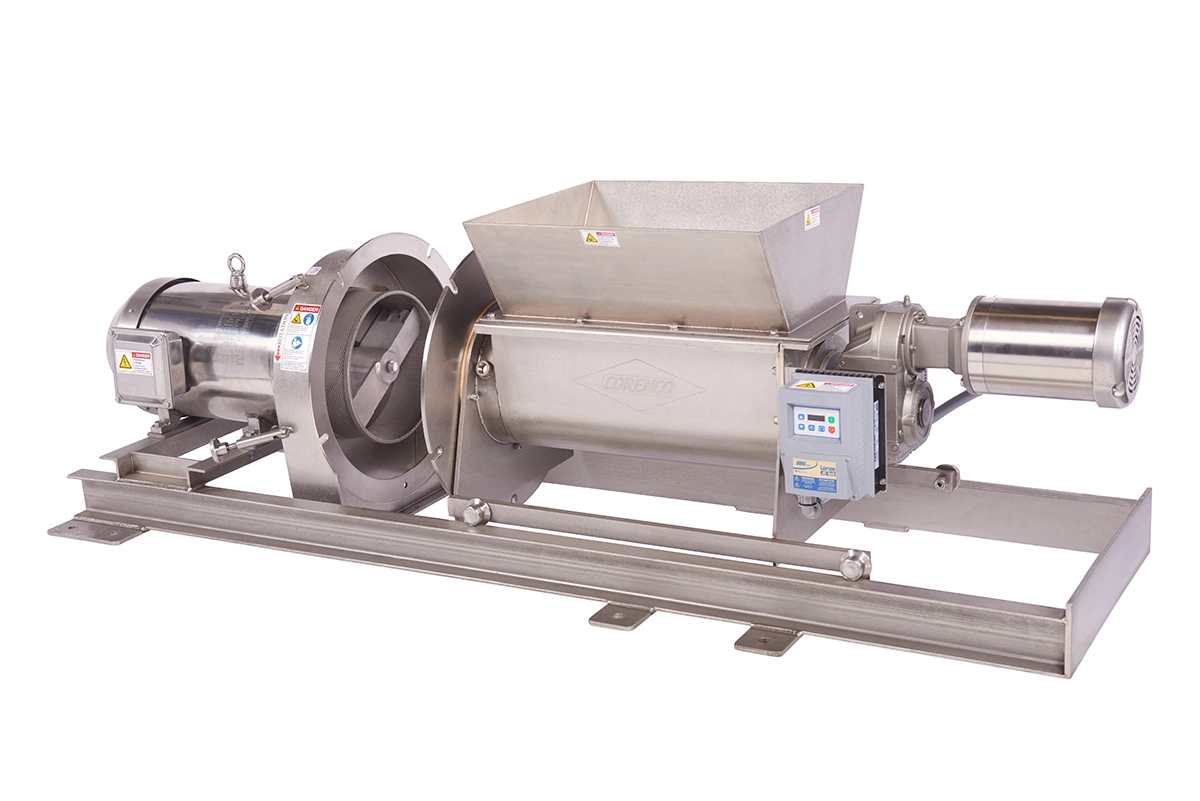
Disintegrators use a high‑speed rotor and screen to produce homogenous purees and slurries with minimal heat build‑up. They excel at processing fruits, root vegetables, rehydrated or freeze‑dried ingredients, gums, starches, hydrocolloids and plant‑based mixes. Corenco’s Angle and Straight‑In‑Feed disintegrators are engineered for sanitary design, high throughput and predictable particle size.
Industrial Grinders – Best for Coarse to Medium Reduction
Grinders are indispensable when pre‑processing tough or fibrous materials. Heavy‑duty models like Corenco’s M‑Series handle tubers (potatoes, beets), fibrous vegetables, waste reduction streams and pre‑grinding before pureeing. Their rugged design allows continuous operation with minimal maintenance, freeing up labor otherwise spent on manual chopping.
Screw‑Fed Systems – For Viscous or Non‑Flowing Materials
When ingredients don’t gravity‑feed well, screw‑fed systems provide a positive feed for dense purees (pumpkin, squash), nut pastes and thick plant‑based slurries. These systems maintain consistent throughput and reduce bridging.
With over 45 years of experience in the food, chemical and pharmaceutical industries, Corenco is known for its sanitary design, high throughput and reliable equipment. Their grinders and disintegrators offer continuous‑duty performance, minimal maintenance and customizable configurations, including gravity‑fed or screw‑fed systems and varied screen sizes.
In food manufacturing, your angle disintegrator is one of the most critical pieces of equipment on the line. When it runs properly, you get consistent particle size, predictable throughput, stable yield, and efficient downstream flow. When it doesn’t, your entire puree or reduction line can slow down—or stop completely.
But how do you know when it’s time to repair an angle disintegrator… and when full replacement is the smarter (and more profitable) decision?
This guide outlines a proven decision framework used by processors handling fruits, vegetables, starches, slurries, beverage bases, and ingredient prep across the food industry.
Quick Answer (AEO Ready)
Repair your angle disintegrator when the issue is limited to replaceable wear parts such as rotors, screens, bearings, shafts, seals, or gaskets—especially if the machine still meets your throughput and particle-size requirements.
Replace your angle disintegrator when repairs become frequent, when the unit can no longer achieve target particle size or throughput, when sanitation compliance becomes difficult, or when parts are obsolete or difficult to source.
Signs You Should Repair—Not Replace
1. Wear Components Are Reaching End of Life (Screens, Bearings, Seals, Rotors)
Angle disintegrators are high-shear machines and naturally experience wear over time.
Repair is the right choice if:
Screens or perforated plates are worn or clogged
Bearings show early-stage noise or heat signs
Seals begin leaking but haven’t caused shaft damage
Rotor edges are rounded but still structurally sound
These components are designed for replacement and can quickly restore optimal performance.
Repair makes sense for wear components. Replacement is the better choice when an angle disintegrator can no longer meet throughput, particle-size, sanitation, or uptime requirements—or when repairs exceed the value of a modernization.
Upgrading to a modern Corenco angle disintegrator improves yield, throughput, and consistency—and often pays for itself quickly.
Understanding the Industrial Nut Butter Process
Let’s break down each stage of large-scale nut butter production, from raw nut preparation to final packaging:
1. Cleaning & Sorting Nuts are cleaned and screened to remove stones, shells, and debris before processing. Equipment: Vibratory sorters, magnetic separators
2. Roasting Enhances flavor while reducing moisture content for smoother grinding. Equipment: Batch or continuous roasters
3. Cooling Stabilizes roasted nuts before grinding to maintain texture and prevent oil separation. Equipment: Cooling conveyors
4. Pre-Grinding / Size Reduction Breaks whole nuts into uniform particles before final grinding. Equipment: Corenco Angle or Screw-Fed Disintegrators
5. Fine Grinding Reduces particles to final fineness and desired texture. Equipment: Colloid or stone mills
6. Mixing & Flavoring Combines sugar, salt, oils, and stabilizers for desired flavor profile. Equipment: Ribbon blenders, planetary mixers
7. Packaging & Cooling Product is filled into jars, tubs, or drums for shipment. Equipment: Filling and packaging systems
Why Size Reduction Matters
Particle size directly influences mouthfeel, oil release, and product stability. Inconsistent size reduction can lead to separation, uneven texture, or overheating during grinding.
Corenco’s size-reduction equipment ensures uniform results with continuous feed systems, optimized rotor design, and food-grade stainless-steel construction for sanitary operation.
Choosing the Right Equipment for Different Nut Types
Nut Type
Processing Challenge
Recommended Equipment
Almonds
High oil content; prone to heat buildup
Screw-Fed Disintegrator
Cashews
Soft texture; may clog in high-volume grinders
Angle Disintegrator
Peanuts
High throughput requirement
Angle Disintegrator
Hazelnuts / Pistachios
Residual shell fragments; harder kernel
Pre-crusher + Disintegrator system
Best Practices for High-Efficiency Production
Maintain optimal feed rate and temperature control to avoid heat damage.
Implement metered feeding for consistent particle size.
Inspect blades, screens, and housings regularly for wear.
Use stainless-steel motors and housings to avoid paint contamination fines.
Follow sanitation standards for FDA and USDA compliance.
Conclusion: The Key to Premium Nut Butter
From almonds to peanuts, premium nut butters depend on precision grinding. Investing in the right industrial size-reduction equipment ensures consistent results, food safety, and scalable output.
In today’s food processing sector, increasing yield isn’t just a production metric—it’s a profit driver. One often‐overlooked step that has a huge impact on both yield and profitability is size reduction — i.e., properly grinding or disintegrating raw inputs so that downstream extraction, blending, pureeing or finishing steps perform optimally. In this post we’ll show how industrial food grinders help maximize yield, why that matters to your bottom line, then look at case‐studies (like legumes → hummus and nuts → butter), and finally share some practical tips on selecting screens and accessories.
Why Proper Size Reduction = Higher Yield
The core idea: Industrial grinders create finer, uniform particles, you can extract more of what you want (juice, oil, soluble material, finished product) with less waste—and with less cost. As Corenco states: “Reduction of fibrous roots, soft vegetables, fruits … the primary purpose of food size reduction equipment is to increase the yield of the material. And increased yield increases profitability.”
Here’s how that plays out in practice:
Smaller particles = more surface area for extraction (for juice, oil, soluble solids)
More uniform size means more consistent downstream process (less under‐processed chunks, less over‐milled waste)
Less retention time, less waste, better capacity utilisation. As Corenco mentions: “Optimal size reduction is the key to … minimizing cost, retention time (and by implication, capacity), waste, and for maximizing yield.”
By improving yield you reduce your per‐unit cost (the raw material cost is better leveraged) which raises margin.
In a competitive market, the business that produces the highest yield and maintains highest quality “wins.”
Example for illustration: If you process apples for juice, and by using a better grinder you extract, say, 5 % more juice per ton of apples, you get more finished product for the same input. That incremental volume can either reduce cost per pound or allow you to sell more, or both—hence boosting profitability.
Yield’s Impact on Profits
Let’s talk numbers in simple terms:
Raw material cost is typically one of the largest components of your cost‐of‐goods‐sold (COGS).
If you can extract 2% more usable product (juice, puree, butter, etc.) from the same input, that’s effectively reducing COGS by 2% (assuming the rest of the process cost stays constant).
That 2% improvement in yield flows straight to margin or allows for more competitive pricing (or to invest in marketing, packaging, etc.).
On high‐volume lines, small yield improvements amplify: e.g., if you process 1,000 tons/month of a raw material, and each ton gives you 100 kg of finished product. A 2% yield gain is 2 kg more finished product per ton → 2,000 kg extra per month. Multiply by your margin and you can see real dollars.
Also, better yield often reflects better process efficiency (less waste, fewer rejects, less downtime) which improves throughput and capacity utilization.
In short, yield optimization via proper size-reduction equipment is not just an “engineering/operations” topic—it is core to business performance and marketing story.
Case Studies
Here are two strong use‐cases where industrial grinders drive yield and value.
1. Chickpeas → Hummus (Legumes to Finished Dip) Legumes (e.g., chickpeas) are a popular input for dips like hummus, spreads and protein‐rich toppings. The process: cooked chickpeas → grinder/puree → blending with other ingredients → final product.
By using an efficient industrial grinder/disintegrator that ensures uniform size, minimal lumps, optimal particle size for blending, you get:
Better texture (a smoother finished dip, which customers prefer)
Less waste (less over‐grinding, fewer rejects)
Higher throughput (faster grinding → more batches) Corenco mentions beans/legumes (hummus) as an explicit application of their size-reduction equipment.
2. Nuts → Nut Butter or Nut Milk Nuts (almonds, peanuts, cashews, etc) processed into nut butters or nut milks require very consistent particle size reduction. If you under‐grind, you get a coarse product, separation issues, inconsistent mouth-feel. If you over‐grind you risk heat build-up, nutrient damage, flavor degradation. Using the right industrial grinder:
Enables optimal final particle size for smooth butter or milk
Enhances extraction of oil/fats (hence increasing yield)
Minimizes rejects, separation and waste.
Tips on Selecting Screens & Accessories for Your Grinder
Screen (or mesh) size matters
Smaller aperture screens produce finer particles, but that’s not always better. In many cases an overly fine grind costs more energy, may damage product, may reduce throughput, or generate unwanted heat or aeration. Corenco: “While many people imagine that the smallest possible screen size will help them create a more premium product, this is yet another place where talking to a manufacturer is critical.”
Bigger screens (coarser grind) may be fine for downstream processes that require larger particles (e.g., soups, chunky sauces) but will under‐extract if you’re aiming for high yield (juice, oil, fine puree).
Optimal screen size depends on: the product’s physical characteristics (wet vs dry, fibrous vs soft), downstream process (extraction vs puree vs finishing), final product specs (texture, mouth-feel). Use trials or send samples for vendor testing—Corenco offers free product testing.
Rotor and internal accessories
Rotor style (chopping rotor, butterfly rotor, paddle‐style) influences how the material is sheared/impacted inside the machine.
Accessories like feeders (screw‐fed vs gravity‐fed vs pump‐fed) matter depending on how sticky or wet the raw material is. For example, leafy greens or wet materials may need a screw‐fed disintegrator rather than gravity‐fed.
Make sure the machine is sanitary and easy to clean if you’re processing food (batch changes, allergens, etc.).
Maintenance & change‐out considerations
Screens wear: Corenco notes that screen lifespan is about 400 working hours (on average) for their machines.
Rotors last longer (e.g., ~2,000 hours) but should be monitored.
Choose equipment where screen swap‐out is quick and tool‐less if possible – fewer downtime losses.
Fit the machine to process volume and feed characteristics
Never assume one size fits all: if your volume doubles you may exceed machine capacity, reducing yield or increasing rejects. Corenco: “The application determines the model … the type of machine you want to invest in will depend largely on what you intend to use it for.”
Consider footprint, power, feed method, and integration into your line (pre‐crusher, disintegrator, finishing).
Work with vendor for trial/testing
Corenco offers testing: send your material, target size and they’ll trial different screens/rotors to optimize before purchase.
Use data from testing to quantify yield improvement, energy usage, throughput – these become marketing‐capable metrics.
Bringing it All Together
For food processing operations aiming to maximize yield and profitability, size reduction should be treated as a strategic lever — not just a “grind it and forget it” step. By investing in the right industrial grinder, optimizing screen/rotor configuration, and aligning it with your product and downstream process, you can:
Improve yields (more juice/puree/butter from the same input).
Reduce waste and lower per-unit costs.
Improve product consistency and texture (a marketing advantage).
Increase throughput and capacity utilization (a business advantage).
Easily build marketing narratives around efficiency, sustainability and premium quality.
Food Grinder Evolution: From Ancient History to Now. For millennia, people have been processing food. For as long as humans have hunted or cultivated crops, we’ve also preserved, dried, milled, and baked raw ingredients. While these tactics began primitively, they’ve steadily become more advanced over the years. Today, commercial food production and processing is a multi-million dollar industry, conservatively, and most of us rely on it in ways we’re not even fully aware of.With that in mind, let’s take a look at the evolution of one crucial piece of food processing equipment – the food grinder – and how it has changed and advanced from ancient times to now.
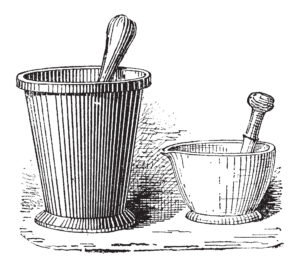
The Original Food Grinder: The Mortar & Pestle
Featuring a curved lip, deep bowl, and thick, oblong pestle, themortar and pestle is a traditional type of food processing equipment that’s been used sinceabout 35000 BCE. Used to crush and grind foods into fine pastes and powders, mortar and pestle sets have always played a critical role in global food processing. Chemists and pharmacists, for example, have traditionally used the tools to grind chemical compounds, while ancient and modern people in the Middle East used massive versions of the vessels to pound meat into kibbeh. These tools remain mostly unchanged today when compared to the versions used by the Sioux, ancient Greeks, Egyptians, and Romans.
Stone Mills
After the mortar and pestle came the advent of the stone mill (also commonly called amillstone), which was typically powered by a water wheel or a lone donkey. These mills were popular as a method to grind wheat, spices, and other grains. Millstones worked in pairs – made of a stationary bedstone and a turning runner stone, which performs the hard work of grinding. These mills were unique in that they crushed the grains fed through them, but kept all parts of the grain, including the germ, bran, and endosperm, intact. Thanks to their construction, millstones ground materials slowly, which means they produce minimal friction and heat. This, in turn, keeps the germ fat from oxidizing and turning rancid, which can destroy some of the nutrients contained in the grain. Today, some small-batch organizations still use millstones, although they’re much less common now than they used to be.
Hammer Mills
After the industrial revolution came hammer mills, which were used for grain milling and producing animal feed. More efficient than mill varieties from decades past, hammer mills made it possible to ramp up output without drastically altering the effort or manpower required to make a product. In terms of construction, a hammer mill is essentially a large, steel drum that houses vertical or horizontal rotating shafts. These shafts provide an anchor point for mounted hammers, which swing freely on the ends of the cross. In some cases, the hammers are secured to a central rotor, which spins rapidly while material filters into the hopper. The hammers pulverize the grains and materials, readying them for the next stage of processing. Late in the 20th-century food grinding became targeted at human consumption, andsanitation started becoming an issue. As such, new food machinery became made out of stainless steel, which is still the case today.
Modern Mills
Today, food processing relies on a complex and varied system of equipment. Crushers, grinders, slicers, and industrial and commercial mixers all play a role in producing the processed and prepared foods we rely on in our daily lives. There’s also been an exciting shift in the focus of food production equipment: while it began as something ancient people utilized for their purposes and then became a tool used by companies and production facilities on a widespread basis, it has shifted and become a personal pursuit, again. Today, personalfood grinding equipment is standard in virtually every kitchen. Most people own a coffee grinder, mortar and pestle, or personal food processor. This represents the full-circle nature of food processing: what started as a personal pursuit has become personal once more.
Corenco: Manufacturing Top-Quality Food Grinders for Decades
As food grinding equipment continues to change, Corenco is proud to stay on the cutting edge of the industry. Creating top-quality food grinding equipment for use in the commercial sector,our products combine longevity, functionality, and durability into one convenient, accessible package. Want to take your food processing operation to the next level? We can help. Our team specializes in helping manufacturing operations identify the equipment solutions that will work best for them, their goals, and their customers.Contact us todayto learn more about our comprehensive lineup of commercial food processing equipment and how we continue to drive the industry forward.


 In today’s food processing sector, increasing yield isn’t just a production metric—it’s a profit driver. One often‐overlooked step that has a huge impact on both yield and profitability is size reduction — i.e., properly grinding or disintegrating raw inputs so that downstream extraction, blending, pureeing or finishing steps perform optimally. In this post we’ll show how